How Do You Know Youre Compatible With Someone
The question, "Are we uniform?" is a fascinating i. Who isn't captivated past the idea of finding their "perfect lucifer"? And it seems similar nearly everyone has an opinion:
- Arranged marriages in gimmicky cultures are often facilitated by a community fellow member who sizes people up.
- Astrologers and numerologists employ their lenses to assess whether a potential human relationship is in the stars...or the cards.
- Some dating apps use algorithms to lucifer lovers using a formula or a set of traits. One example is Chemistry.com, which partnered with evolutionary biologist Helen Fisher to connect users based on the neurochemistry of 4 different encephalon systems.
- Even Buzzfeed creates cute quizzes and snappy "What would you do if?" questions to decide compatibility between quiz-takers and their partners.

Source: Jelena Zelen/Shutterstock
Compatibility is typically framed in a formulaic, trait-based style. We wonder, "Practise opposites concenter?" or "Exercise birds of a plumage flock together?" In other words, should we value the complementarity betwixt partners or cherish the similarities that bring the states together? Regardless of which side you're on, the mere thought of matching with a perfect partner based upon your personality and/or inherent characteristics is understandably heady.
A Different Approach to Compatibility
While exploring this topic with students and clients over the by 20 years, I have long said, "Narrative trumps traits." What do I mean by this? No listing of traits can peradventure capture the complexities of honey, so I desire people to focus on stories rather than qualities. Rather than asking, "Are nosotros uniform?" ask, "What is this love story all about?"
Focusing on how, for example, one of you is an introvert (trait) and i of you lot is an extrovert (trait) creates fearfulness: Nosotros can't possibly understand each other or build a life together because we are different. Focusing instead on the story of the difference creates compassion, curiosity, and possibility: "Your introversion grounds me, and my extroversion challenges you lot. We piece of work together to create a relationship that honors both of our ways of being in the earth." Research by Samantha Joel reinforces this framework.
So, if the joint narrative of a couple supersedes their private traits, and so why practice we feel such a strong desire to focus on a trait-based view of compatibility? I think we seek a formula to demark the tremendous feet and vulnerability inherent in loving and being loved. We crave a certainty that assures us that the take chances of opening our hearts will be worth it. When we experience relationship doubt (as we inevitably will), we seek a list of characteristics in another that can either guide u.s. back home or permit u.s.a. know that the situation is untenable. The trouble, of course, is that beloved refuses to play past a slap-up and tidy set of rules.
When the question of compatibility becomes the topic of the conflict, this indicates that ane or both partners is/are feeling misunderstood or devalued. It is a cue to intermission the chat until each partner can imagine the conflict from the other person's perspective. One powerful tool for doing this comes from Eli Finkel's research: Step away and write near the disharmonize from the perspective of a neutral 3rd party who loves you both very much. This practice moves you away from focusing on whose traits are getting in the way and refocuses you on the story of the problem.
The Gift of Incompatibility
There are also gifts hidden within our incompatibilities. If your story is that loving your partner across this difference gives you that chance to learn, grow, flex, and extend yourself, then you can actually become grateful for the differences between you. The "incompatibility" gifts y'all insights and opportunities:
- To seek what you lot need elsewhere, taking pressure off your partner and your relationship to be your everything
- To practice patience, humility, and grace
- To continue to acquire how to love your partner in ways that experience good for them, and to ask your partner to love you in ways that experience good for you
By providing a fleck of contrast, incompatibilities tin can be blessings in disguise.
Compatibility in Action
Recently, I polled my Instagram community to learn more than about their perspectives on compatibility. I asked them to complete the sentence, "I know we are compatible when..." and I conducted a "qualitative gene assay" of the responses, grouping the information into three broad categories (shown in the table). I was struck past how well their responses fit with the story-not-trait framework.
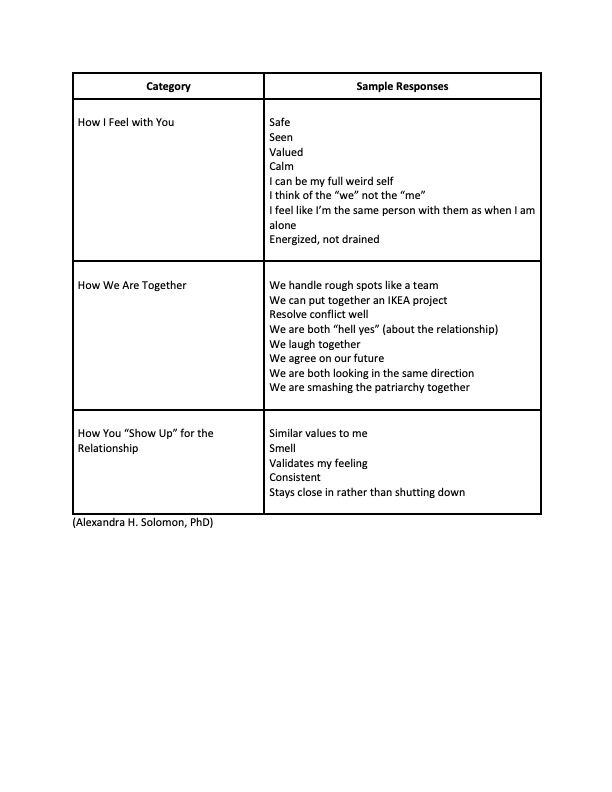
Compatibility Table
Source: Alexandra H. Solomon, PhD
As seen here, the notion of compatibility seems to expand past the basic idea of sharing similar characteristics with a partner. In fact, beingness on the same folio or fifty-fifty in agreement on a topic is barely alluded to in the table above. Instead, compatibility appears as both a deeply individual and relational experience. These responses suggest that many feel compatible with their partner when, in a higher place all else, they feel validated and seen. I wonder what might happen when nosotros consider compatibility to be something that occurs "between us" rather than "within you lot or me."
Perhaps compatibility isn't really nigh finding a perfect match—information technology's well-nigh fostering a relationship with a partner who is willing to be curious and engaged across your differences.
Practice gentleness and grace as you communicate your relational needs and run across if this story-based model of compatibility helps you discover new ways to appreciate your partner.
Relational Self-Sensation Questions Nigh Compatibility
I hope these reflections on compatibility feel helpful to you whether you are looking for love, falling in love, or nurturing your relationship. I want to go out yous with a Relational Self-Awareness boosting do and some journal questions to solidify your shifted perspective on compatibility.
Relational Cocky-Awareness Exercise: Make a list of the qualities that you most value in an intimate partner. Review the list and inquire yourself this question, "To what degree do I embody these qualities myself?"
Relational Cocky-Awareness Reflection Questions:
- What does compatibility hateful to me?
- What part of me practice I virtually want my partner to meet and validate?
- Why is it so important to me to have this office of me seen and validated in my human relationship?
- How do I feel when this part of me feels seen?
- How practice I feel when this part of me feels unseen?
- What three words all-time capture what I want and need in an intimate partnership?
- Consummate the sentence: "I know we are uniform when…"
Facebook image: Jelena Zelen/Shutterstock
References
Finkel, East. J., Slotter, E. B., Luchies, 50. B., Walton, G. Thousand., & Gross, J. J. (2013). A brief intervention to promote conflict-reappraisal preserves marital quality over time. Psychological Scientific discipline, 24, 1595-1601.
Joel, S., Eastwick, P. W., & Finkel, E. J. (2017). Is romantic desire predictable? Automobile learning practical to initial romantic allure. Psychological Scientific discipline, 28, 1478-1489.
collinsworthevanight.blogspot.com
Source: https://www.psychologytoday.com/us/blog/loving-bravely/202107/how-couples-know-theyre-compatible
0 Response to "How Do You Know Youre Compatible With Someone"
Post a Comment